Because apparently learning Japanese wasn't challenging enough, I now need to save the world while doing it.
Over the last week and a half, I've felt a noticeable shift in my Japanese learning. I'm spending less time obsessing over how many hours I've studied or how many words I've memorized and more time thinking about what I can actually do with the language.
My lessons with Akiko are progressing, Pimsleur is moving along, my journal entries are becoming more connected, and particles are slowly becoming less of a personal enemy. I've also stepped back from studying kanji in isolation, preferring to learn them through vocabulary and sentences where they have meaning.
But there's one piece of my learning that I haven't quite figured out yet: immersion.
Finding Immersion That Actually Works for Me
I recently tried watching My Neighbor Totoro in Japanese. It's a lovely movie, and I understand why so many people recommend it to Japanese learners.
But good lord, those little girls scream a lot.
Between the screaming, the vocabulary I didn't know and the speed of the dialogue, I found myself becoming more annoyed than immersed. If I stopped the movie every time I didn't understand something, I probably would have finished it sometime next year.
I'm also starting to question how productive immersion is when I'm spending most of the experience completely lost. I want to challenge myself, but there's a difference between being challenged and staring blankly at a screen while occasionally recognizing the word ありがとう.
So I started thinking about approaching immersion differently.
What if I already knew the story? What if I understood the characters, their motivations, the world they lived in and what was happening around them? Could I remove some of the mental effort of following a story and redirect it toward understanding the Japanese?
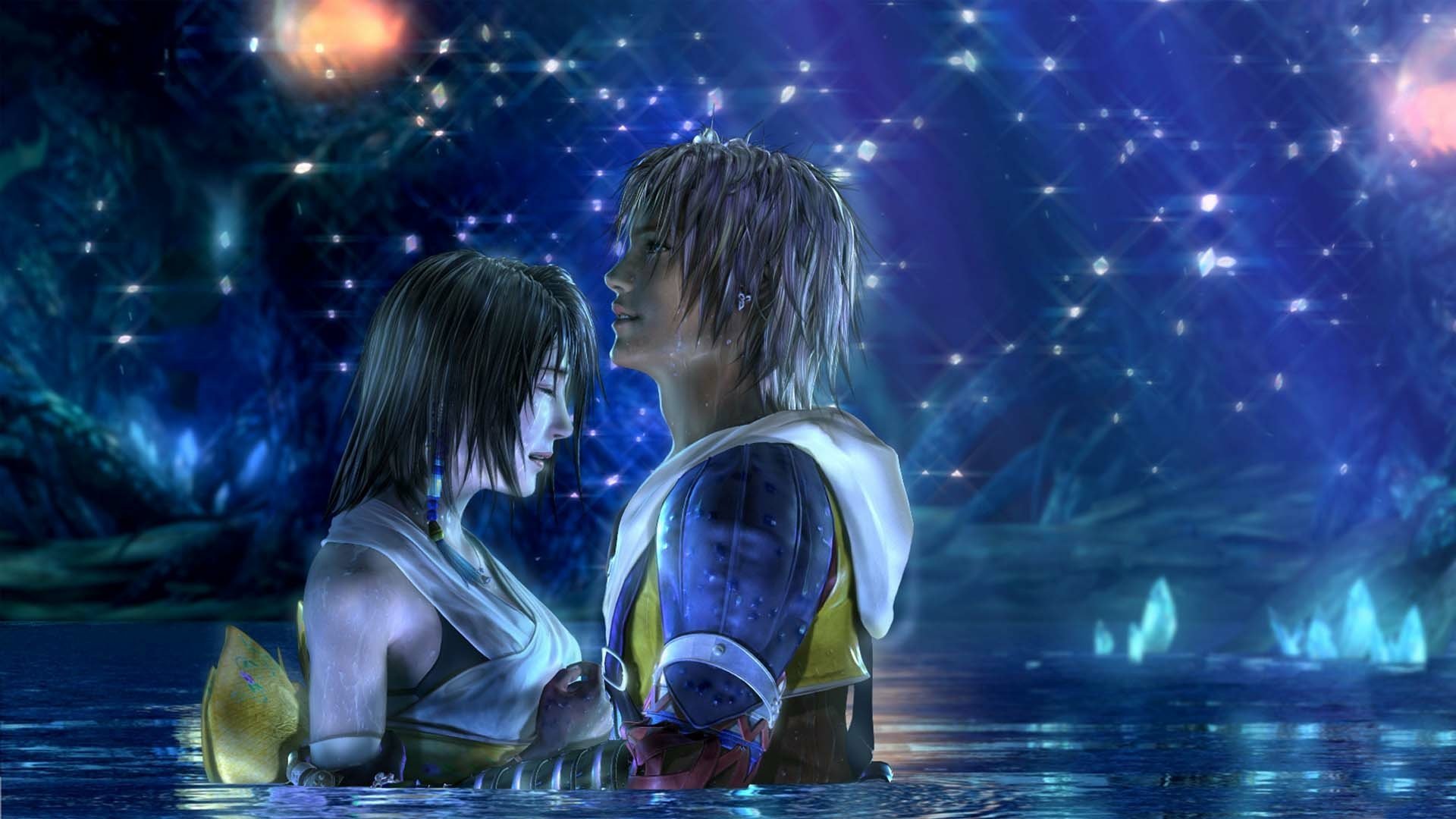
Enter Final Fantasy X.
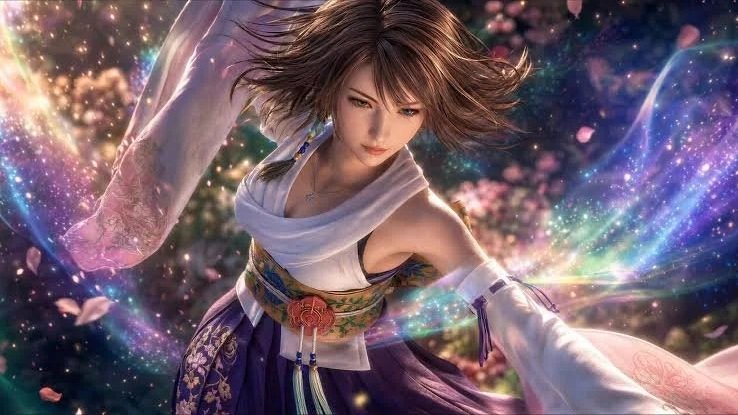
Returning to Spira
I've played Final Fantasy X several times, across multiple gaming systems, over the years. I know the characters, the story, the battle mechanics and the emotional moments. There isn't much about the game that's going to surprise me at this point.
Except, apparently, what everyone is saying.
That's precisely why I think it could be such an interesting learning opportunity. Even when I don't understand a sentence, I have years of familiarity with the game to help me piece together its meaning.
There are a few things that make Final Fantasy X particularly appealing as an immersion tool:
I'm already emotionally invested in the story.
Much of the written dialogue can be read at my own pace.
The main story features Japanese voice acting.
Vocabulary and expressions repeat throughout the adventure.
Characters have distinct personalities and speaking styles.
I already understand the gameplay mechanics.
Unfortunately, the game doesn't provide furigana above the kanji. That would have made my life considerably easier, but apparently Spira has no interest in accommodating my N5 problems.
The voice acting should help bridge some of that gap, though, allowing me to connect written Japanese with how it actually sounds.
Studying Before Playing
Rather than jumping straight into the game and collecting every word I don't understand, I want to reverse the process.
I'm going to study the Japanese before I encounter it.
I found a Japanese Final Fantasy X dialogue archive that conveniently organizes the game into 13 chapters - I did need chatgpt to decode the site, as it is OLD. Using that structure and the events throughout the game, I worked with ChatGPT to develop a series of chapter-specific Anki decks.
The result is a collection of 960 flashcards across 13 chapters, designed to progressively introduce vocabulary and grammar relevant to the adventure.
The first chapter contains 215 cards, establishing a foundation of common vocabulary, conversational expressions and action verbs. Later chapters introduce fewer new words because the intention is for previously learned vocabulary to carry forward.
My plan is relatively simple:
Study the vocabulary for the upcoming chapter.
Play that section of the game entirely in Japanese.
Make note of recurring words and expressions I still struggle with.
Review what I've learned and prepare for the next chapter.
I'm aiming for somewhere around 70–80% comprehension over time.
I don't expect to understand everything, and I don't particularly want to spend 200 hours preparing to play a 50-hour game. Finding that balance will be part of the experiment.
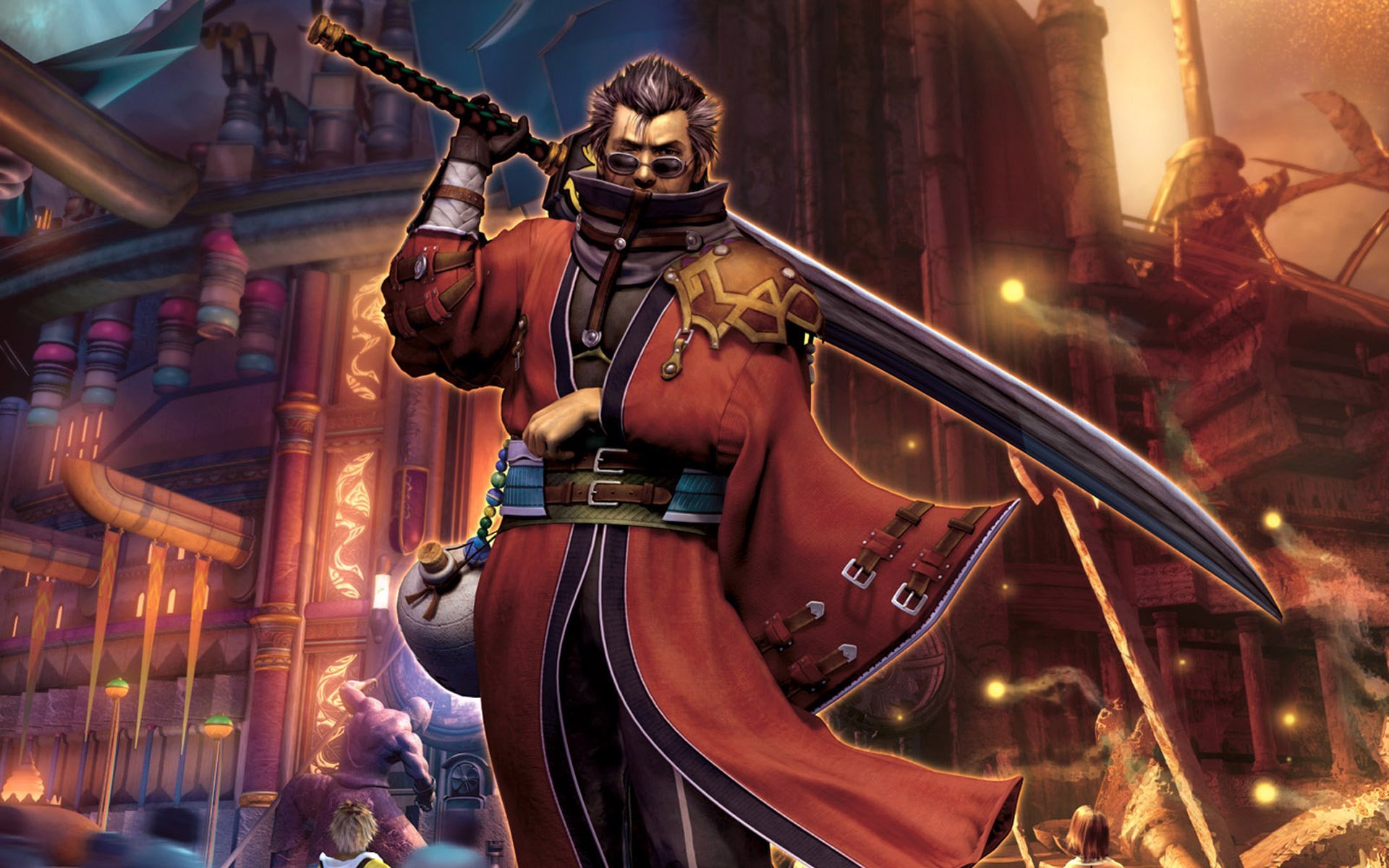
How the Anki Cards Are Designed
I've been refining the way I build Anki cards recently, particularly through my work with Japanese graded readers.
I don't want to simply memorize a Japanese word and its English equivalent. I want to understand how the word behaves within a sentence, how it's pronounced and how it interacts with the grammar surrounding it.

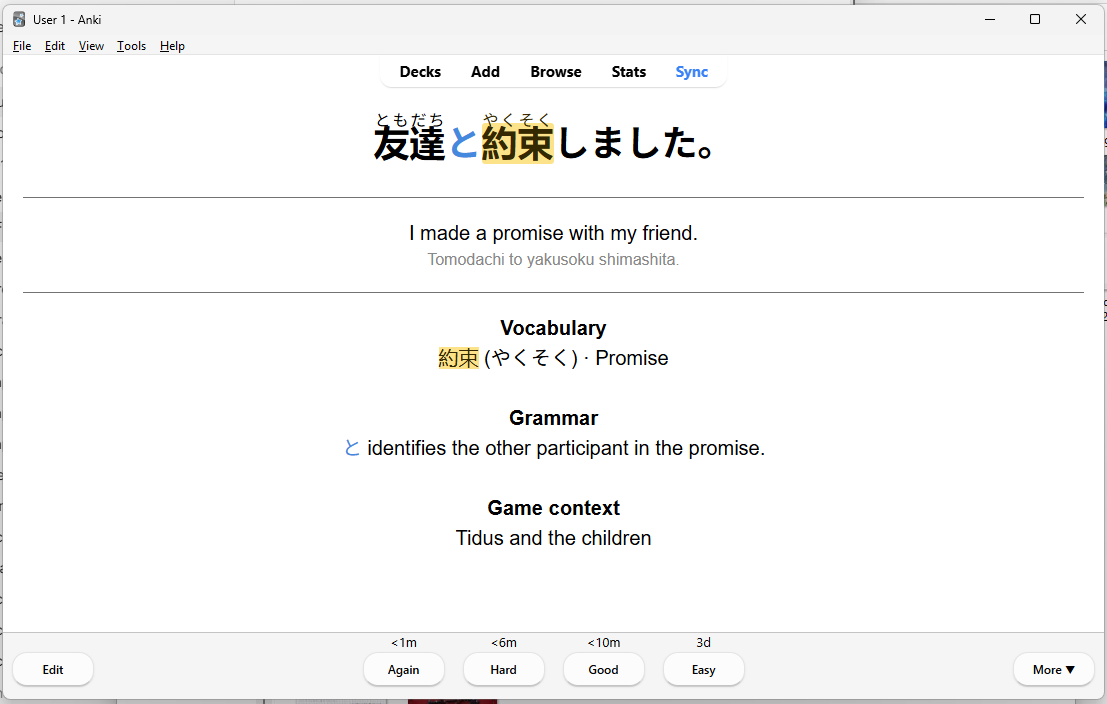
Each card includes:
A Japanese sentence with furigana above the kanji.
A yellow background highlighting the core vocabulary.
Blue text identifying the particles within the sentence.
An English translation and romaji.
The dictionary form and meaning of the target word.
Grammar commentary explaining the sentence and relevant particle choices.
Context connecting the vocabulary to the game.
The practice sentences have been simplified and adapted around the game's dialogue, scenes and vocabulary. They aren't intended to be exact transcriptions.
That's intentional. At my current level, studying a complicated native sentence that contains six things I don't understand isn't particularly helpful when I'm trying to learn one new word.
I'd rather understand the word in a simpler sentence first and then challenge myself to recognize it in its more complicated, natural form during gameplay.
It also gives me another opportunity to reinforce particles, which, despite our increasingly complicated relationship, I am finally starting to understand.
Download the Final Fantasy X Anki Decks
Since I've already gone through the effort of putting these decks together, I figured I might as well share them with anyone interested in trying something similar.
[Download all 13 Final Fantasy X Anki decks here]
The download contains 13 individual TXT files, one for each chapter, with a combined total of 960 cards.
These are AI-assisted learning materials that I'm experimenting with myself, rather than professionally reviewed Japanese teaching resources. There may be errors, and I expect to refine the decks as I actually play through the game.
How to Import the Decks into Anki
Download and extract the ZIP file. Open the desktop version of Anki, select File > Import, and choose the TXT file for the chapter you want to study.
Use the following import settings:
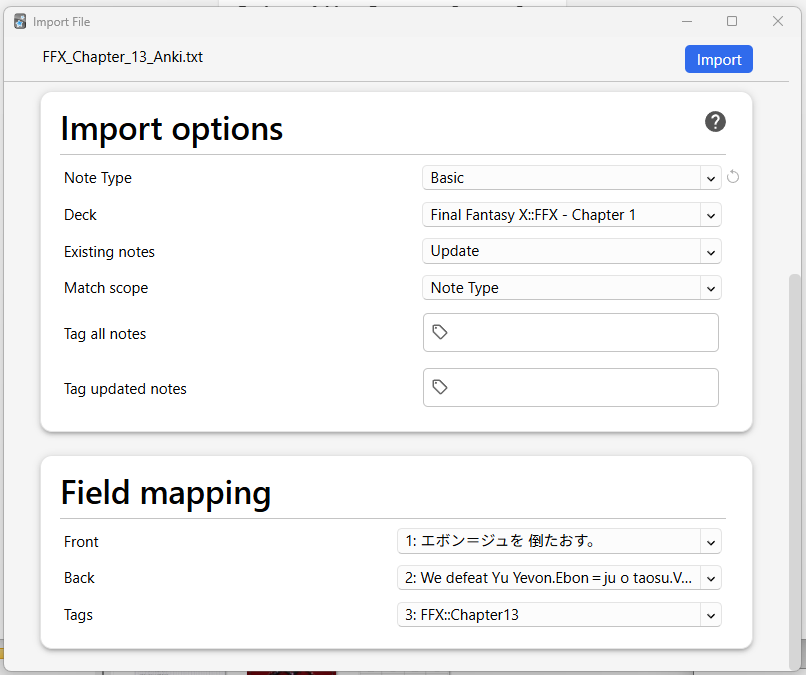
Repeat the process for each chapter, changing the destination deck to match the chapter number.
Make sure HTML is enabled. Otherwise, the furigana, vocabulary highlighting and particle coloring won't display correctly.
Will This Actually Work?
I have absolutely no idea.
That's part of what makes this fun.
One of the things I'm learning about learning Japanese is that not every method that works for someone else is going to work for me. I'm becoming more comfortable experimenting, changing direction and abandoning approaches that aren't adding enough value.
I don't want Japanese to become an endless cycle of flashcards, textbooks and structured lessons. I want it to become something I can experience through the things I already enjoy.
If I can gradually connect the Japanese I've been learning with a world I've loved for years, that feels like a pretty meaningful milestone.
And if nothing else, I'll finally discover whether Tidus is as annoying in Japanese as he is in English.
いっしょにがんばろう!
—
A Chapter-by-Chapter Learning Journey
Below, I've broken down each of the 13 chapters, including a synopsis of the story, the vocabulary being introduced and an overview of what each deck is designed to teach.
The curriculum begins with relatively foundational Japanese before gradually introducing more complex vocabulary surrounding relationships, religion, politics, sacrifice, identity and philosophy.
Fair warning: there are spoilers. Although, if you've managed to avoid Final Fantasy X spoilers for more than two decades, I'm genuinely impressed.
-
215 Anki cards | Cumulative vocabulary: 215
Story synopsis: The story begins in Zanarkand, where Tidus is preparing for a blitzball match when the mysterious entity known as Sin attacks the city. With Auron's help, Tidus attempts to escape but finds himself transported to an unfamiliar world. After exploring ancient ruins and encountering Rikku and the Al Bhed, he eventually arrives near the island of Besaid.
Japanese learning focus: This chapter establishes the vocabulary foundation for the entire game. The deck concentrates on everyday verbs, introductions, questions, directions, time expressions, survival vocabulary and conversational Japanese.
Key vocabulary:
試合(しあい): Match
約束(やくそく): Promise
遺跡(いせき): Ruins
仲間(なかま): Companion
逃げる(にげる): To escape
千年(せんねん): One thousand years
Deck review: The largest deck in the curriculum, Chapter 1 introduces vocabulary that will continue appearing throughout the adventure. It also begins bridging the gap between polite textbook Japanese and the more casual language used by characters like Tidus and Auron. The sentences are simplified around game scenes, rather than verified quotations, and the target dialogue coverage has not been independently measured.
-
Descri139 Anki cards | Cumulative vocabulary: 354
Story synopsis: On the island of Besaid, Tidus begins learning about Spira, its people and the teachings of Yevon. He meets Yuna, a young summoner preparing to undertake her pilgrimage, along with her guardians. The group eventually departs Besaid, beginning a journey that will challenge everything Tidus understands about the world.
Japanese learning focus: Religious terminology, introductions, relationships, personal responsibilities, emotions and travel.
Key vocabulary:
召喚士(しょうかんし): Summoner
召喚獣(しょうかんじゅう): Aeon
祈り子(いのりご): Fayth
教え(おしえ): Teachings
試練(しれん): Trial
役目(やくめ): Duty
Deck review: Chapter 2 establishes much of the fictional terminology necessary to understand Spira while continuing to develop practical conversational Japanese. The vocabulary introduces concepts of duty, faith and responsibility that become increasingly important throughout the story. Yuna's polite speaking style also provides an interesting contrast to Tidus's casual Japanese.ption text goes here
-
90 Anki cards | Cumulative vocabulary: 444
Story synopsis: The party witnesses the destruction left behind by Sin in Kilika. Yuna performs the Sending, guiding the souls of the deceased to the Farplane. The group continues through Kilika's forest and temple before departing for Luca, learning more about the previous pilgrimage undertaken by Braska, Jecht and Auron.
Japanese learning focus: Exploration, navigation, combat, personal history and emotional experiences.
Key vocabulary:
故郷(ふるさと): Hometown
攻撃(こうげき): Attack
回復(かいふく): Recovery
弱点(じゃくてん): Weakness
経験(けいけん): Experience
憧れる(あこがれる): To admire
Deck review: This chapter balances gameplay terminology with highly transferable everyday Japanese. Directional vocabulary, movement verbs and descriptions of past experiences make the deck useful well beyond the game. It also introduces different applications of familiar particles, such as using を to identify a route being traveled rather than the object of an action.
-
101 Anki cards | Cumulative vocabulary: 545
Story synopsis: The party arrives in Luca for the blitzball tournament. Tidus encounters the excitement of competitive blitzball once again, while the group is introduced to Seymour. Yuna's kidnapping interrupts the tournament, Wakka prepares for his final match, and Auron returns with revelations that begin reshaping Tidus's understanding of Sin.
Japanese learning focus: Sports, competition, public events, social interactions and emergency situations.
Key vocabulary:
観客(かんきゃく): Spectators
応援(おうえん): Cheering or support
誘拐(ゆうかい): Kidnapping
得点(とくてん): Scoring
引退(いんたい): Retirement
正体(しょうたい): True identity
Deck review: Chapter 4 introduces an extensive collection of sports vocabulary alongside action-oriented verbs associated with searching, pursuing, escaping and rescuing. The competitive setting provides opportunities to learn language applicable to real-world sporting events, while the character interactions introduce more personal and emotional expressions.
-
77 Anki cards | Cumulative vocabulary: 622
Story synopsis: Leaving Luca behind, the party travels along the Mi'ihen Highroad. Encounters with historians, summoners, travelers and Crusaders reveal more about Spira's history and religious traditions. Meanwhile, preparations are underway for an ambitious military operation intended to defeat Sin.
Japanese learning focus: History, travel, accommodation, commerce, organizations and beliefs.
Key vocabulary:
街道(かいどう): Highway
組織(そしき): Organization
協力(きょうりょく): Cooperation
ナギ節(なぎせつ): The Calm
作戦(さくせん): Operation or strategy
覚悟(かくご): Resolve
Deck review: This is one of the most transferable chapters for practical Japanese. Conversations with travelers and merchants introduce vocabulary surrounding transportation, accommodation and shopping. The historical and military discussions also introduce more advanced concepts involving leadership, cooperation, regulations and decision-making.
-
46 Anki cards | Cumulative vocabulary: 668
Story synopsis: Operation Mi'ihen ends in catastrophe, demonstrating the overwhelming power of Sin. The survivors are forced to confront the consequences of their decisions, while Yuna and her guardians continue their pilgrimage through Spira.
Japanese learning focus: Conflict, consequences, grief, loss and perseverance.
Key vocabulary:
犠牲(ぎせい): Sacrifice
全滅(ぜんめつ): Annihilation
生存者(せいぞんしゃ): Survivor
絶望(ぜつぼう): Despair
希望(きぼう): Hope
諦める(あきらめる): To give up
Deck review: Building upon the military terminology introduced in Chapter 5, this deck shifts toward the emotional consequences of conflict. The vocabulary becomes increasingly abstract, introducing expressions associated with regret, encouragement, determination and loss. These concepts will return throughout the remainder of the game.
-
43 Anki cards | Cumulative vocabulary: 711
Story synopsis: With Rikku joining the pilgrimage, the party travels to Guadosalam. Seymour presents Yuna with a marriage proposal, introducing a new responsibility for her to consider. A visit to the Farplane allows the characters to reconnect with memories of those they have lost.
Japanese learning focus: Relationships, memories, personal feelings, marriage and decision-making.
Key vocabulary:
招待(しょうたい): Invitation
相談(そうだん): Consultation
結婚(けっこん): Marriage
選択(せんたく): Choice
懐かしい(なつかしい): Nostalgic
本心(ほんしん): True feelings
Deck review: One of the strongest chapters for everyday conversational Japanese. The vocabulary moves away from physical actions and toward expressing opinions, discussing relationships and describing personal feelings. Seymour's more formal language also introduces a different style of communication from the informal conversations that dominate earlier chapters.
-
41 Anki cards | Cumulative vocabulary: 752
Story synopsis: The pilgrimage continues through the dangerous Thunder Plains, where Rikku struggles with her fear of lightning. Meanwhile, Yuna considers Seymour's proposal and its implications for Spira. The group eventually enters the mysterious Macalania Woods.
Japanese learning focus: Weather, environmental descriptions, physical sensations, fear and personal needs.
Key vocabulary:
雷鳴(らいめい): Thunder
稲妻(いなずま): Lightning
避難(ひなん): Taking shelter
我慢(がまん): Endurance
休憩(きゅうけい): Break
輝く(かがやく): To shine
Deck review: A relatively approachable chapter that reinforces practical Japanese through environmental descriptions and everyday needs. The vocabulary includes expressions for taking breaks, seeking shelter and describing discomfort. Rikku's reactions also create opportunities to explore how emotions and requests are expressed in casual Japanese.
-
43 Anki cards | Cumulative vocabulary: 795
Story synopsis: Following a confrontation with Seymour at Macalania Temple, the party is separated and eventually reunites in the desert. Their journey leads them to the Al Bhed Home, where Tidus finally learns the devastating truth about the Final Summoning and the sacrifice Yuna has been preparing to make.
Japanese learning focus: Truth, deception, morality, sacrifice and consequences.
Key vocabulary:
真実(しんじつ): Truth
証拠(しょうこ): Evidence
裏切る(うらぎる): To betray
救出(きゅうしゅつ): Rescue
究極召喚(きゅうきょくしょうかん): Final Summoning
代償(だいしょう): Price or sacrifice
Deck review: Chapter 9 marks a significant increase in linguistic complexity. Understanding the story increasingly depends on abstract concepts rather than descriptions of physical actions. The deck also introduces passive verb forms and vocabulary associated with deception and consequences. The emotional intensity of the dialogue makes this a particularly challenging section for listening comprehension.
-
41 Anki cards | Cumulative vocabulary: 836
Story synopsis: The party attempts to rescue Yuna from her wedding to Seymour in Bevelle. Their actions lead to capture, trial and escape. Following these events, Tidus and Yuna share one of the game's most memorable and intimate moments in Macalania Woods, confronting the conflict between their feelings and Yuna's duty.
Japanese learning focus: Marriage, justice, personal freedom, romance and aspirations.
Key vocabulary:
結婚式(けっこんしき): Wedding ceremony
誓う(ちかう): To vow
強制(きょうせい): Coercion
裁判(さいばん): Trial
抱きしめる(だきしめる): To embrace
叶う(かなう): To come true
Deck review: This chapter combines formal institutional language with deeply personal conversations. The marriage vocabulary builds upon Chapter 7, while the legal terminology reinforces concepts introduced in Chapter 9. The romantic dialogue presents a new challenge through expressions of desire, regret and imagined possibilities.
-
44 Anki cards | Cumulative vocabulary: 880
Story synopsis: Yuna resolves to continue her pilgrimage despite everything the party has learned. The group crosses the Calm Lands and ascends Mount Gagazet, where Kimahri confronts his past. Tidus discovers more about the nature of his existence before the party finally reaches the ruins of Zanarkand.
Japanese learning focus: Identity, perseverance, honor, personal growth and responsibility.
Key vocabulary:
種族(しゅぞく): Race or species
誇り(ほこり): Pride
名誉(めいよ): Honor
乗り越える(のりこえる): To overcome
困難(こんなん): Hardship
絆(きずな): Bond
Deck review: The vocabulary becomes increasingly philosophical as the characters confront questions of identity and purpose. This chapter also introduces useful compound verbs, helping learners recognize how familiar Japanese words combine to create more complex meanings. The themes of perseverance and personal responsibility make much of this vocabulary relevant outside the game.
-
40 Anki cards | Cumulative vocabulary: 920
Story synopsis: In Zanarkand, the party discovers the true nature of the Final Summoning and confronts Yunalesca. Rejecting the cycle of sacrifice that has defined Spira for generations, they search for an alternative way to defeat Sin. With the help of the airship, they prepare for their final confrontation.
Japanese learning focus: Problem-solving, strategy, destiny, alternatives and challenging established beliefs.
Key vocabulary:
方法(ほうほう): Method
手段(しゅだん): Means
可能性(かのうせい): Possibility
実行(じっこう): Execution
宿命(しゅくめい): Destiny
抗う(あらがう): To resist
Deck review: Chapter 12 brings together many of the religious, historical and strategic concepts introduced throughout the curriculum. Its vocabulary is particularly valuable for learning how to discuss possibilities, evaluate alternatives and make decisions. Several of these expressions are also applicable to professional Japanese and everyday problem-solving.
-
40 Anki cards | Cumulative vocabulary: 960
Story synopsis: The party enters Sin and confronts Seymour, Jecht and Yu Yevon, bringing the cycle of destruction and summoning to an end. With the fayth finally released from their dream, Auron departs and Tidus begins to disappear. Yuna addresses the people of Spira as they look toward a future free from Sin.
Japanese learning focus: Farewells, memories, gratitude, loss, renewal and hope.
Key vocabulary:
支配(しはい): Domination
消滅(しょうめつ): Disappearance
目覚める(めざめる): To awaken
復興(ふっこう): Reconstruction
感謝(かんしゃ): Gratitude
見送る(みおくる): To see someone off
Deck review: The final chapter brings together the emotional and philosophical vocabulary developed across the entire curriculum. Expressions surrounding dreams, memories, relationships and loss return with greater significance. Rather than relying solely on newly introduced words, this chapter provides an opportunity to recognize familiar vocabulary in increasingly complex and emotionally meaningful Japanese dialogue.